Table of contents13 sections
- Air Freight from China to UAE: When It Makes Sense and When You Are Wasting Money in 2026
- Answer summary
- The 2026 rate landscape
- The decision matrix: when air, when sea, when express
- Three worked examples
- Example 1: 200 kg of electronics, urgent restock
- Example 2: 4,000 kg of furniture, planned replenishment
- Example 3: 80 kg of beauty samples, time-critical
- Air freight cost factors that change the headline rate
- When express courier beats standard air freight
- What to ask any air freight forwarder
- How SamVertex air freight compares
- When air freight is the wrong call
- Frequently asked questions
- See your real numbers
- References
Air Freight from China to UAE: When It Makes Sense and When You Are Wasting Money in 2026
Air freight from China to UAE costs USD 4 to USD 8 per kg in 2026 market rates, with express courier sitting at USD 7 to USD 20 per kg, and SamVertex's published all-in air freight at AED 35 per kg (roughly USD 9.50). Transit is 5 to 7 days door-to-door. Sea freight runs USD 30 to USD 75 per CBM, takes 25 to 38 days door-to-door, and is dramatically cheaper for anything above 300 kg or 2 to 3 CBM. The decision is rarely about which mode is faster. It is about which mode is wasting your money for the cargo profile you actually have.
Most air freight content on the internet is sales-driven from forwarders pushing the higher-margin product. SamVertex sells air freight too, but we will tell you when sea is the right call. The article below gives you the decision matrix, the math, and three worked examples that settle the question for typical UAE seller cargo profiles.
Answer summary
Air freight from China to UAE makes sense for shipments under 300 kg or 2 to 3 CBM, urgent restocks where every stockout day costs more than the freight premium, high-value cargo where freight is a small percent of cargo value (electronics, fashion, beauty), perishables and time-sensitive samples, and emergency Q4 inventory pulls when sea freight cut-offs have passed. Air freight is the wrong call when the cargo is bulk consumer goods at moderate value, when the sea freight cycle fits the seller's cash flow, when freight cost would exceed 15 to 20 percent of cargo value, or when "fast" is a feeling rather than a calculation.
The 2026 rate landscape: standard air freight USD 4 to USD 8 per kg from major Chinese hubs (Shanghai, Shenzhen, Guangzhou) to Dubai International (DXB) or Al Maktoum (DWC), via Emirates SkyCargo, Qatar Airways Cargo, or Cathay Cargo. Express courier (DHL Express, FedEx, UPS) USD 7 to USD 20 per kg, faster but more expensive per kg. SamVertex's published rate is AED 35 per kg (roughly USD 9.50) all-in including UAE-side customs and last-mile to your warehouse.
The decision frame: calculate the per-percentage-point freight burden against cargo value at both modes, factor stockout cost against transit gap, and pick the mode where the math works. The next sections show how.
The 2026 rate landscape
Three pricing tiers for moving cargo from China to UAE by air, with real 2026 market data:
| Mode | Rate per kg (USD) | Transit door-to-door | Best for |
|---|---|---|---|
| Standard air freight | $4 to $8 | 5 to 7 days | 300 to 5,000 kg, business-as-usual urgent stock |
| Express courier (DHL/FedEx/UPS) | $7 to $20 | 2 to 5 days | Under 200 kg, samples, emergency replenishment |
| Premium express | $10 to $25 | 1 to 3 days | Sub-100 kg, time-critical, high-value |
| SamVertex air freight | AED 35 (~$9.50) | 5 to 8 days | All-in UAE-side handling included |
Standard air freight is what most importers use for shipments between 300 kg and roughly 5,000 kg. Below 300 kg, express courier minimums make standard air freight uneconomical. Above 5,000 kg, the cost scales linearly while sea freight savings start to dominate.
Express courier is the right tool for samples, emergency parts, and shipments under 200 kg where the door-to-door simplicity (one operator handles pickup, customs, delivery) is worth the per-kg premium. DHL Express, FedEx, UPS Worldwide all run reliable China-to-UAE express services with 2 to 5 day transit.
Premium express (DHL Express same-day, FedEx International Priority) is for situations where the freight cost is small compared to the cost of being late. A USD 50,000 product launch missed by 48 hours is a different equation than a USD 5,000 stockout.
The chargeable weight rule applies to every air mode: you pay the higher of actual weight or volumetric weight, calculated as length × width × height in cm, divided by 6,000. A 100 cm × 60 cm × 40 cm carton at 30 kg actual weight has a volumetric weight of 40 kg, so you pay for 40 kg. Bulky lightweight cargo (foam products, plastic items, garments) gets penalized by the volumetric calculation; dense cargo (metal parts, electronics, books) bills on actual weight. Knowing your cargo's density before requesting quotes is the difference between a quote that holds and a quote that triples on the invoice.
The decision matrix: when air, when sea, when express
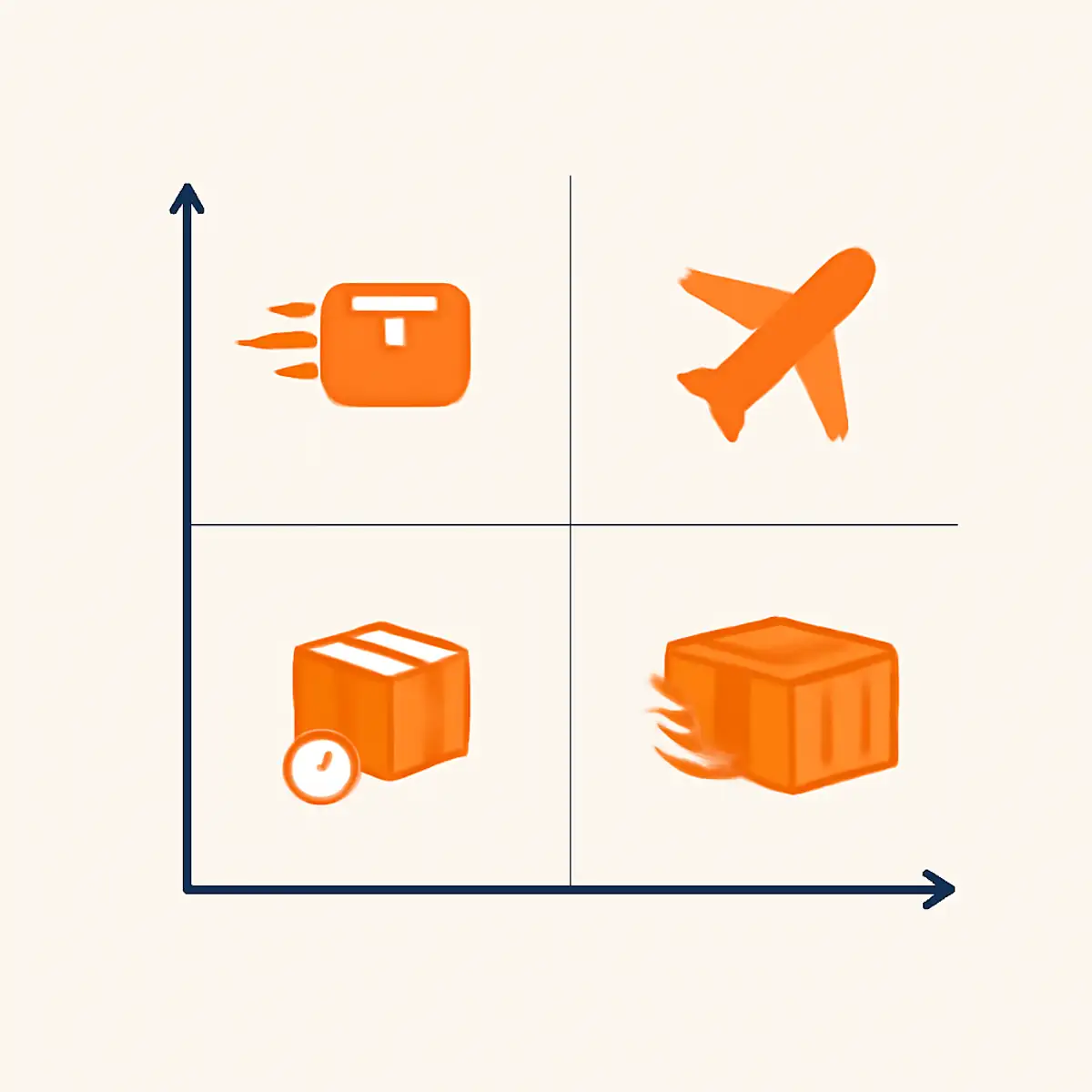
The clean version of the question: at what cargo volume and urgency does air freight beat sea freight on total economic cost?
                       URGENCY (days you can wait)

                    1-3 days        4-10 days        11-25 days       26+ days
                  ─────────────   ─────────────   ─────────────   ─────────────
Under 50 kg       │ Express+    │ Express      │ Standard air │ Standard air │
                  ─────────────   ─────────────   ─────────────   ─────────────
50 to 300 kg      │ Express     │ Standard air │ Standard air │ LCL sea      │
                  ─────────────   ─────────────   ─────────────   ─────────────
300 to 1,000 kg   │ Standard air│ Standard air │ LCL sea      │ LCL sea      │
                  ─────────────   ─────────────   ─────────────   ─────────────
1,000 to 5,000 kg │ Standard air│ LCL sea      │ LCL sea      │ FCL sea      │
                  ─────────────   ─────────────   ─────────────   ─────────────
5,000 kg+         │ Standard air│ FCL sea      │ FCL sea      │ FCL sea      │
                  ─────────────   ─────────────   ─────────────   ─────────────
                                                              VOLUME
The matrix is a starting point, not an absolute. Three modifiers shift the call:
Cargo value as percent of freight. When freight is 20 percent of cargo value, the math hates air freight. When freight is 1 percent of cargo value, you can almost always justify air on the speed gain. The threshold most operators use: if standard air freight cost would exceed 15 to 20 percent of cargo declared value, sea is the better call regardless of urgency, because the freight premium dominates.
Stockout cost. A retailer running 100 orders per day at AED 50 average order value loses AED 5,000 per stockout day in revenue, plus customer-acquisition cost on those buyers, plus reputation cost. If air freight saves 14 days versus sea, the saved revenue is AED 70,000. That math justifies a much higher freight cost than the headline rate suggests.
Cargo restrictions. Some cargo cannot fly. Lithium batteries above certain capacities, certain liquids, perishables with shelf-life shorter than the air transit cycle, items with certain regulatory paperwork that takes longer than the air transit. The freight choice gets made for you.
Three worked examples
Three realistic UAE seller scenarios, with real numbers, to show how the decision actually shakes out.
Example 1: 200 kg of electronics, urgent restock
A consumer electronics seller running on Amazon UAE and Noon hits a stockout warning. Inventory is 200 kg of phone cases, screen protectors, charging cables. Cargo value approximately USD 8,000 wholesale. Sales velocity 80 units per day across SKUs.
Sea freight option: ~0.4 CBM cargo. LCL minimum charges apply (most LCL forwarders charge a minimum of 1 CBM). Effective rate: USD 75 per CBM with 1 CBM minimum = USD 75. Plus origin charges USD 80, destination charges USD 50, plus duties and VAT. Subtotal freight USD 205. Door-to-door transit 28 days. Lost sales during transit gap: 80 units/day × 14 days versus air = 1,120 units lost at USD 30 average sale price = USD 33,600 revenue lost. Net cost: USD 33,805.
Standard air freight option: 200 kg at USD 6 per kg market rate = USD 1,200. Plus customs and last-mile bundled into SamVertex's all-in rate at AED 35 per kg = AED 7,000 (USD 1,905). Transit 6 days. Lost sales during transit gap: 80 units/day × 0 days versus immediate replenishment = USD 0 incremental loss. Net cost: USD 1,905.
Decision: air freight wins by USD 31,900. The decision becomes obvious once stockout cost is in the math.
Example 2: 4,000 kg of furniture, planned replenishment
A home goods seller on their own Shopify plus marketplace listings. Restocking living room furniture (sofas, side tables, accent chairs). Cargo value approximately USD 35,000 wholesale. 4,000 kg is roughly 24 CBM by volumetric weight (high-volume low-density). Sales velocity 8 units per day, current inventory covers 30 days.
FCL sea freight option: 24 CBM fits in a 20ft container. Market rate USD 1,500 to Jebel Ali. Plus origin/destination/duties/VAT, total all-in approximately USD 3,200. Transit 28 days door-to-door. Inventory just covers the gap, no stockout.
Standard air freight option: 4,000 kg at USD 5.50 per kg average = USD 22,000. Plus customs, total approximately USD 23,500. Transit 6 days. Saves 22 days versus sea, but saved revenue is USD 0 because there is no stockout.
Decision: sea freight wins by USD 20,300. The decision is also obvious once stockout cost is zero. Air freight on planned replenishment for bulk goods is wasted money.
Example 3: 80 kg of beauty samples, time-critical
A beauty brand launching on Amazon UAE next month. 80 kg of product samples, packaging, marketing inserts for a launch event. Cargo value approximately USD 4,500 (samples are not for sale, but represent committed inventory). Hard deadline in 8 days for the event.
Sea freight option: sub-1 CBM. LCL minimum applies. Even at minimum LCL pricing, transit is 28 days. Misses the deadline by 20 days. Decision: not viable.
Standard air freight option: 80 kg at USD 6 per kg = USD 480. Plus customs, total approximately USD 720. Transit 6 days. Hits the deadline with 2 days margin. Net cost: USD 720.
Express courier option: 80 kg at USD 14 per kg average = USD 1,120. All-in (express courier bundles customs and delivery), no extra costs. Transit 3 days. Hits the deadline with 5 days margin. Net cost: USD 1,120.
Decision: standard air freight is the right call. Express courier costs USD 400 more for 3 extra days of buffer that the deadline does not require. If the buffer reduces project risk enough to justify USD 400, choose express. Otherwise standard air freight wins.
The pattern across all three: the right freight mode is the one where the freight cost plus the cost-of-delay equals the lowest total. Cost-of-delay is the variable most importers leave out of the calculation.
Air freight cost factors that change the headline rate
The USD 4 to USD 8 per kg headline obscures real cost variability. Five factors that move quotes:
Origin airport. Shanghai (PVG), Shenzhen (SZX), Guangzhou (CAN), and Hong Kong (HKG) have different base rates and different airline mixes. Hong Kong typically runs cheapest for outbound to UAE because of higher cargo carrier density. Shanghai is most reliable for capacity. Shenzhen and Guangzhou compete for South China cargo.
Destination airport. Dubai International (DXB) is the primary cargo gateway to the UAE, the 11th-busiest cargo airport globally. Al Maktoum International (DWC) at Dubai South is growing as the secondary cargo hub. Abu Dhabi International (AUH) and Sharjah International (SHJ) are alternatives, often with cheaper local handling rates but less cargo flight frequency. The right destination airport is the one closest to your final delivery address; trucking from DXB to Sharjah can erase the per-kg savings of routing through SHJ.
Carrier choice. Emirates SkyCargo, Qatar Airways Cargo, and Cathay Cargo run direct services and command premium rates. Etihad Cargo and Turkish Cargo run via transhipment hubs (Abu Dhabi, Istanbul) with slightly lower rates and slightly longer transit. Chinese carriers (Air China Cargo, China Cargo Airlines) also serve the lane.
Booking lead time. Air cargo space tightens during peak weeks (Chinese New Year run-up in January, Golden Week in October, Q4 e-commerce peak). Booking 7 to 10 days ahead during peak gives the best rates and capacity. Same-day or next-day bookings during peak can run 30 to 50 percent above standard rates.
Cargo characteristics. Dangerous goods (lithium batteries, certain chemicals) require certified handlers and pay premium rates. Oversized cargo pays per-piece premiums. Perishable cargo with cold-chain requirements pays cold-chain handling fees. Standard general cargo is the published rate.
The realistic rate band: USD 4 to USD 8 per kg for general cargo, USD 6 to USD 12 per kg for special handling, USD 7 to USD 20 per kg for express courier, USD 10 to USD 25 per kg for premium express same-day services.
When express courier beats standard air freight
Express courier is not just "fast air freight." It is a different operating model that wins in specific scenarios.
Shipments under 200 kg. Standard air freight has minimum chargeable weights (often 45 kg) and minimum invoice charges that make small shipments uneconomical. Express courier prices small shipments efficiently because their network is built for parcel-scale economics.
Door-to-door simplicity. Express courier handles pickup at the supplier's factory, export clearance, transit, import clearance, and final delivery to your warehouse. No separate customs broker. No coordination across origin and destination operators. One waybill, one operator, one invoice.
Urgent samples and prototypes. Pre-launch samples for retail buyers, pre-production prototypes for engineering reviews, marketing materials for events, all the cargo where the freight cost is small compared to the project value of being on time.
Emergency replenishment. A retailer hitting an unplanned stockout. The math from Example 1 above scales: if the freight premium is USD 500 and the saved sales revenue is USD 30,000, express courier is the obviously correct call.
DHL Express, FedEx International Priority, and UPS Worldwide Express all run 3 to 5 day China-to-UAE transit at USD 7 to USD 12 per kg standard rates, with same-day and next-day service tiers at USD 15 to USD 25 per kg. The freight forwarders running consolidated express services (Winsky Freight, DDPCHAIN, DocShipper) often beat the published carrier rates by 30 to 50 percent on standard service through volume agreements with the carriers, while still using the same carrier networks.
What to ask any air freight forwarder
Six questions that surface a real operator versus a sales pipeline:
-
What is the chargeable weight calculation on my specific cargo? A real operator asks for dimensions and weight before quoting, calculates volumetric weight, and quotes on the higher of the two. A sales pipeline quotes a per-kg rate assuming actual weight and re-quotes when the cargo arrives at the airport.
-
Which carrier and route? "We use multiple carriers" is a non-answer. The right answer is "Emirates SkyCargo direct PVG-DXB on the Tuesday and Friday departures, with Qatar Airways Cargo as backup if capacity tightens." Specificity reveals operational depth.
-
What is included in the per-kg rate? Origin pickup? Export clearance? Fuel surcharge? Security surcharge? Destination handling? Customs clearance? Last-mile delivery? Each of these can add USD 0.50 to USD 2 per kg if not included. The all-in rate matters more than the headline rate.
-
What is the transit time door-to-door, including customs? Flight time is 8 hours. Door-to-door is 5 to 7 days because of pickup, export handling, customs clearance, and last-mile. An operator who quotes "2-day transit" is quoting flight time, not door-to-door.
-
What happens if my cargo is denied loading or held at customs? Real operators have documented escalation paths and absorb the cost of operator-side errors (mislabeled boxes, missing paperwork they should have caught). Sales pipelines push the cost back to the importer.
-
Can you reference a recent shipment of similar size and origin? A real operator can name the lane, the cargo type, and the transit time on a shipment they ran in the last 90 days. Specifics build credibility; generalities erode it.
How SamVertex air freight compares
SamVertex's published rate is AED 35 per kg (roughly USD 9.50), all-in to UAE warehouse. The all-in pricing includes:
- Origin pickup from your supplier's factory (within 50 km of major Chinese cargo hubs; further pickup quoted per case)
- Export customs clearance in China
- Air freight on Emirates SkyCargo, Qatar Airways Cargo, or Cathay Cargo direct services
- UAE import customs clearance including MOFAIC attestation
- 5 percent UAE customs duty and 5 percent VAT calculation and payment processing
- Last-mile delivery to your UAE warehouse anywhere in the UAE
Compared against the standard market band of USD 4 to USD 8 per kg, the SamVertex rate sits at the higher end of the band as a per-kg comparison. The math equalizes once UAE-side costs are added: a quote at USD 5 per kg China-side typically runs USD 8 to USD 11 per kg landed once destination handling, customs broker fees, MOFAIC attestation (AED 150 per invoice), and last-mile delivery are added.
Where SamVertex air freight wins: sellers who want a single operator end-to-end with no UAE-side handoffs, sellers running on SamVertex's 3PL services who want the air freight to arrive directly at the Ras Al Khor warehouse for storage and fulfillment, sellers without an established UAE customs broker relationship.
Where it loses: high-volume importers who can negotiate direct rates with the airlines and run their own UAE customs broker. The math typically favors direct relationships above 50,000 kg per year. Below that, the all-in operator is usually cheaper after total cost-of-ownership accounting.
For sellers comparing air against sea, our companion article on sea freight from China to UAE covers the math on the other side of the decision.

When air freight is the wrong call
Three scenarios where air freight is being chosen for the wrong reason:
"Faster feels safer." First-time importers often pay the air freight premium because they have not yet built confidence in the sea freight cycle. The cost of that confidence is real, often USD 5,000 to USD 30,000 per shipment. The right answer is to learn the sea freight cycle (see our sea freight guide) and switch to sea once the cash flow can handle the 28-day cycle. The "fast feels safer" choice is rarely wrong on the first shipment but is almost always wrong by the third.
Air freight as a stockout fix. If your demand forecasting is wrong often enough that air freight is your backup plan, the demand forecasting is the problem, not the freight. Air freight as planned emergency replenishment costs the seller real money and signals weak inventory planning to anyone watching the books. The right fix is better stock cover (extra 14-day buffer) and better demand forecasting, with air freight reserved for genuine emergencies (supplier defects, customs issues at sea, unexpected demand spikes).
The 20 percent freight rule. When standard air freight would be 20 percent or more of declared cargo value, the freight premium is destroying the unit economics of the cargo itself. A USD 8 per kg air rate on USD 40 per kg cargo is 20 percent, which is the threshold where most operators start questioning whether the cargo should be air shipped at all. Below that, air freight is a normal cost of doing business; above that, the cargo profile and the freight choice are misaligned.
Frequently asked questions
How much does air freight from China to UAE cost in 2026?
USD 4 to USD 8 per kg for standard air freight on shipments above 300 kg. Express courier (DHL, FedEx, UPS) USD 7 to USD 20 per kg, with the lower end on shipments above 1,000 kg and the higher end on sub-100 kg parcels. SamVertex publishes AED 35 per kg (roughly USD 9.50) all-in including UAE-side customs and last-mile.
How long does air freight from China to UAE take?
5 to 7 days door-to-door for standard air freight (1 to 2 days flight plus pickup, customs, and last-mile). 2 to 5 days for express courier. 1 to 3 days for premium express same-day services. Flight time alone is 8 to 10 hours; the rest is operational handling on both ends.
What is chargeable weight and how is it calculated for air freight?
Air freight bills on the higher of actual weight or volumetric weight. Volumetric weight (kg) = (Length cm × Width cm × Height cm) / 6,000. A 100 × 60 × 40 cm carton has a volumetric weight of 40 kg, which becomes the billing weight if actual weight is below 40 kg. Bulky lightweight cargo (foam products, garments, plastics) bills on volumetric weight; dense cargo (metals, electronics, books) bills on actual weight.
When does sea freight beat air freight from China to UAE?
Above 300 kg or 2 to 3 CBM with cargo value below USD 50 per kg, sea freight typically wins on total cost. Above 5,000 kg sea freight wins almost always except for true emergency restocks. The decision flips when stockout cost during the longer sea transit exceeds the air freight premium, which usually happens for high-velocity SKUs on planned replenishment failures.
Can I ship lithium batteries by air freight from China to UAE?
Yes, with restrictions. Lithium-ion batteries above 100 watt-hours and lithium-metal batteries above 2 grams require certified hazardous goods handling, documentation under IATA dangerous goods regulations, and capacity restrictions on passenger flights. Cargo-only flights have looser restrictions but still require the IATA paperwork. Plan for 5 to 10 days extra lead time for hazardous goods preparation and confirm with the forwarder which carrier accepts your specific battery profile.
What documents do I need for air freight from China to UAE?
The same core set as sea freight: commercial invoice (MOFAIC-attested for shipments over AED 10,000), packing list, air waybill (AWB) issued by the carrier or forwarder, certificate of origin, valid UAE trade license, and any product-specific permits (MOIAT for electronics, MoCCAE for food, etc.). The MPCI manifest filing requirement applies to sea freight only, not air.
Does the UAE charge customs duty on air freight imports from China?
Yes, the same 5 percent duty on CIF value (Cost + Insurance + Freight) plus 5 percent VAT on customs-cleared value. The mode of transport (air vs sea) does not change the duty rate, only the freight portion of the CIF calculation.
What is the cheapest airport to ship into in the UAE?
Dubai International (DXB) for most cargo because of flight frequency and competitive carrier rates. Al Maktoum (DWC) for cargo destined for Dubai South or Jebel Ali area. Sharjah (SHJ) and Abu Dhabi (AUH) sometimes have cheaper local handling rates but less direct flight frequency, so the true landed cost depends on your delivery address and total cost-of-ownership across handling and trucking.
Should I use a Chinese forwarder or a UAE-side operator for air freight?
Both work, with different trade-offs. Chinese forwarders (DDPCHAIN, DocShipper, Winsky Freight, Basenton) often have cheaper origin handling and better rate negotiation with carriers. UAE-side operators (SamVertex, Aramex, DHL Supply Chain) have stronger UAE customs depth and direct accountability for last-mile delivery. The single-source DDP model from either end usually wins on coordination cost; the two-operator FOB split sometimes wins on transparency and rate control for high-volume importers.
See your real numbers
Air freight from China to UAE is the right call when the math says so, not when the forwarder says so. Run your specific cargo profile through the decision matrix above, factor stockout cost honestly, and the answer becomes clear. SamVertex publishes air freight at AED 35 per kg all-in, with UAE-side customs and last-mile to your warehouse included.
Send your cargo specifics (weight, dimensions, origin city, destination address, target delivery date) to /contact/ and we will share the right freight mode recommendation, with the math, within 24 hours. If sea freight is the better call for your shipment, we will tell you. Honest math beats freight pitches every time.
References
- SamVertex air freight service page for the AED 35 per kg rate detail
- SamVertex sea freight service page for the AED 499 per CBM comparison rate
- SamVertex sea freight from China to UAE guide for the comparison-mode deep dive
- SamVertex 3PL pricing guide for Dubai 2026 for UAE-side fulfillment rate context
- Sino-Shipping, "Freight Shipping from China to UAE, Updated May 2026," https://www.sino-shipping.com/country-guides/freight-from-china-to-uae/
- DDPCHAIN, "Shipping from China to UAE: Air, Sea & DDP Costs (2026)," https://ddpchain.com/uae/
- DTFU Logistics, "Shipping Cost from China to Dubai 2026 Guide," https://www.dtfulogistics.com/news/shipping-cost-from-china-to-dubai/
- Tonlexing, "Sea Freight vs Air Freight from China to the UAE," https://www.tonlexing.com/sea-freight-vs-air-freight-from-china-to-the-uae/
- DocShipper, "Shipping from China to United Arab Emirates in 2026," https://china.docshipper.com/en/freight-shipping-china-uae/
Ready to stop reading and start shipping?
We run a real warehouse in Dubai and answer every message. Free consultation, no pressure, no commitment.
We reply within 4 hours during business hours.